
By Jeff Gilder, WingDing® Media – July 2026
Back in October, standing in the wreckage of WBD’s third rejected Paramount bid, we laid three bets on the table. Ellison’s Encore, 60% odds: Paramount reloads and eventually wins the whole company. We called it. Warner shareholders approved Paramount Skydance’s $31-a-share buyout in April, closing the book on a bidding war that also, briefly, saw Netflix walk away with the bigger prize before getting cold feet.
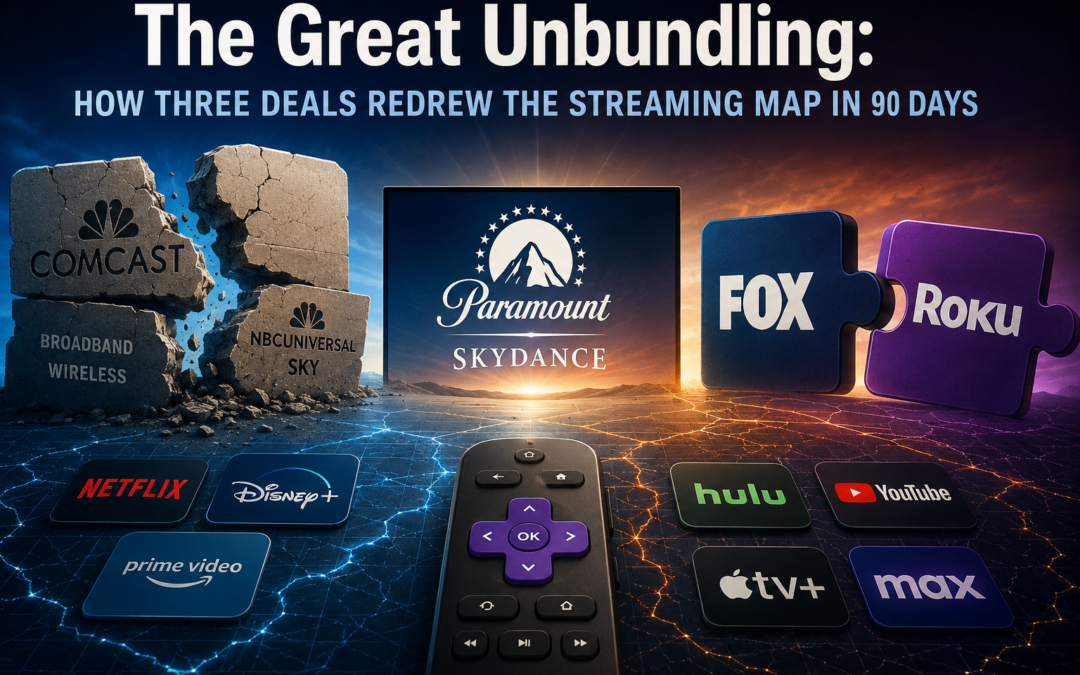
But here’s the twist our crystal ball missed: while everyone was watching WBD bleed out, two other bombs went off. Comcast tore itself in half — again. And Fox, of all companies, just wrote a $22 billion check for the plumbing that half the country uses to watch television. If Q1’s story was “who wins WBD,” Q3’s story is “distribution just ate content for lunch, twice.”
The Verdict Is In: Paramount Wins, But Not the Way Anyone Called It
The full timeline is worth the receipts, because the streaming industry’s favorite trope — “the obvious winner takes it in the first round” — didn’t hold up:
| Stage | Date | What Happened |
|---|---|---|
| Second-round bids | Nov 20 – Dec 1, 2025 | Netflix, Paramount, and Comcast all submit competing offers for WBD’s studio and streaming assets |
| Netflix takes the lead | Dec 5, 2025 | WBD’s board picks Netflix’s cash-and-stock deal (~$82.7B) over Paramount |
| Paramount refuses to fold | Jan–Feb 2026 | Hostile board slate, shareholder litigation, Delaware Chancery Court fight over WBD’s disclosure |
| Netflix folds instead | Feb 26, 2026 | Netflix declines to match Paramount’s higher offer |
| Shareholders approve | April 2026 | Paramount’s $31/share, ~$111B (with debt) deal for the entire company gets the green light |
Ellison got his encore. He just had to sit through Netflix’s opening act first. The lesson for anyone tracking these fights: the “superior offer” and the “winning offer” are two different things when litigation and stomach for risk enter the picture.
Comcast’s Not Done Breaking Up
We covered the Versant spinoff in detail two weeks ago (read here), so we won’t re-run that tape — but the sequel matters. On June 29, Comcast announced it’s spinning off NBCUniversal and Sky (Peacock, NBC, Telemundo, Universal Studios, the theme parks) into a fully separate public company, leaving the parent focused purely on broadband and wireless. That’s the second Comcast breakup in six months. Comcast’s stock popped nearly 23% in pre-market trading on the news, even after shares had fallen roughly 30% over the prior year.
Read the tea leaves: distribution (broadband, pipes, wireless) wants to be valued on its own, cash-generating terms — and content (studios, streaming, theme parks) increasingly gets sent off to fend for itself. That’s the same thesis we’ve been running since spring, now playing out at the biggest media company in America, twice in one year.
The One Nobody Saw Coming: Fox Buys Roku
If WBD was the slow-motion car crash everyone rubbernecked at for a year, Fox/Roku was the sucker punch. On June 15, Fox Corp announced it’s acquiring Roku for $160/share in cash and stock — roughly $22 billion in enterprise value. The deal pairs Fox’s live sports, news, and Tubi with Roku’s connected TV platform, its first-party data, and its direct relationship with more than 100 million streaming households worldwide.
Think about what that actually means: the guy who owns the content just bought the company that makes the remote. Roku commands the operating system on a huge share of American TVs — it’s the front door millions of people walk through before they ever open Netflix or YouTube. Fox just bought the front door. The deal makes the combined company the third-largest player in U.S. television by share of viewing, and Fox is funding it with a $12 billion loan while its own stock dropped 17% on the news — Wall Street clearly needs convincing.
This is the mirror image of the traditional media playbook. Instead of a content company buying distribution to protect its library (Disney/Fox, WarnerMedia/Discovery), a content-and-live-sports company bought the CTV platform to make sure it’s never at the mercy of somebody else’s home screen again. If that pattern holds, watch for Paramount, WBD, or NBCUniversal to make a similar move rather than wait to be squeezed by whoever owns the next Roku.
Netflix’s Turn: The Big Print Lands July 16
By the time you’re reading this, Netflix will have (or be about to) report Q2 earnings. The guidance going in: $12.57B in revenue, up 13.5% year-over-year, with an operating margin target of 32.6% — down slightly from a year ago as content amortization peaks for the year. Ad revenue is on pace to nearly double to roughly $3 billion in 2026, and paid memberships were already past 325 million as of Q1. Worth watching: whether the ad business and live sports/events push (Netflix’s newest growth levers) are enough to keep the “profitability king” crown, or whether the market starts pricing in the same content-spend fatigue that’s hitting everyone else.
Sports Fragmentation: Still Nobody’s Friend But the Leagues’
The NBA’s new 11-year, $76 billion media rights deal — more than triple its prior contract — now scatters games across ESPN/ABC, NBC/Peacock, and Amazon Prime Video. Paramount+ is paying $7.7 billion over its UFC deal, more than double what ESPN paid previously. The upshot for actual humans: a true sports fan now needs somewhere between 8 and 10 subscriptions to cover the NFL, NBA, and MLB alone, stacked on top of whatever live-TV package they’re already paying for. Leagues are printing money. Fans are drowning. Nothing new under the sun here — just bigger numbers every quarter.
AI Discovery: The Next Battleground
Buried under the M&A headlines is a quieter shift that matters more long-term: a majority of Gen Z and millennial viewers now say they get better content recommendations from social platforms like TikTok and YouTube than from the streaming services themselves. That’s a brutal stat for an industry that spent the last five years building recommendation engines as their core moat. Expect the back half of 2026 to bring a wave of “AI-native discovery” features — conversational search, mood-based recommendations, agentic content curation — as platforms scramble to keep viewers from bouncing to social for their “what should I watch” fix.
What’s Next: Q4 2026 Odds
- Fox/Roku Closes Clean (65% odds): Regulatory review is a formality; the bigger risk is integration, not approval. Expect Fox to start bundling Tubi/Fox One more aggressively into the Roku home screen well before the deal officially closes.
- NBCUniversal Spinoff Draws a Suitor (35% odds): Comcast insists this isn’t an M&A play. Nobody believes that for a full year. If Peacock’s numbers wobble, expect circling from Netflix or a PE consortium before the spin even completes.
- AI Discovery Becomes a Marketing Line Item (75% odds): By year-end, expect at least two major platforms to ship a conversational “ask the app what to watch” feature as a headline product push, not a backend tweak.
The distribution war didn’t slow down this quarter — it just found new battlefields. Content is still abundant. Attention is still scarce. But now the fight for the front door — the remote, the home screen, the algorithm — is where the real money’s moving.
WingDing® Media: Where Media Meets Momentum. Follow us on socials @watchwingding.