
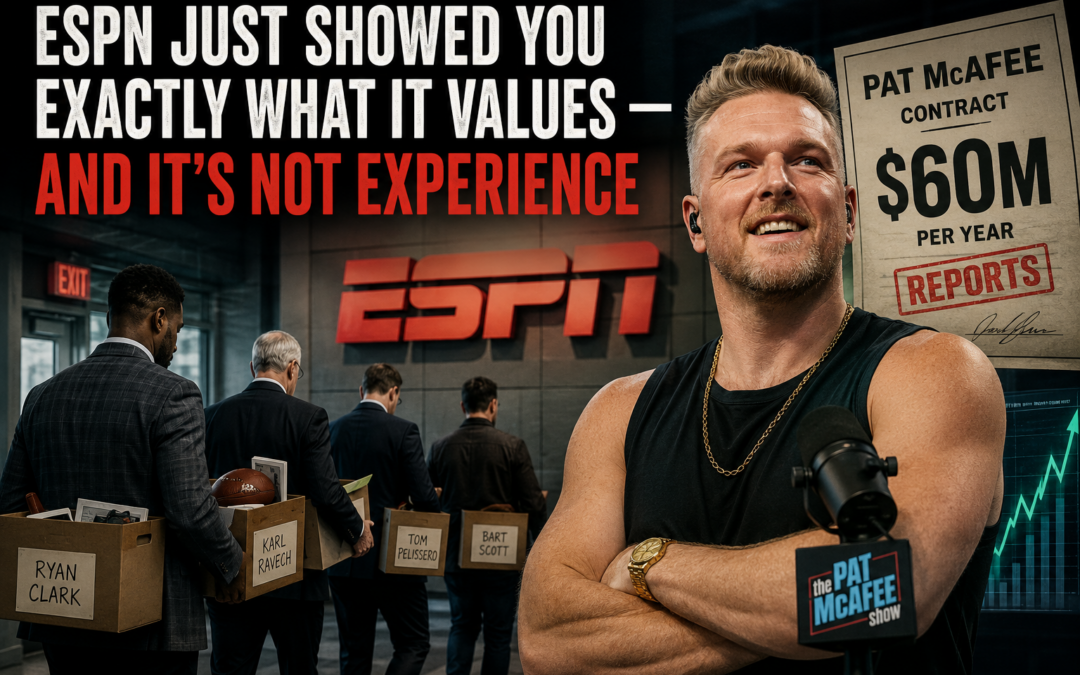
ESPN laid people off again this week. If you’ve stopped reacting to that sentence, I don’t blame you — it’s become close to an annual ritual in Bristol. But this round is worth stopping on, because it’s not just another headcount trim. It’s a tell.
Among those shown the door: Ryan Clark, a 13-year NFL veteran turned analyst whose exit broke live, on-air, mid-broadcast. Karl Ravech, 33 years at the network, the voice of Sunday Night Baseball for a generation. Tom Pelissero, Cam Newton, Bart Scott — real names, real tenure, real audiences.
At the same time, reports have ESPN closing in on a new deal for Pat McAfee that would roughly double his existing $30 million-a-year contract, pushing him toward the $60 million range. One analyst, one show, one personality — getting paid more than the combined weight of the résumés walking out the door.
That’s not a coincidence. That’s a budget decision with a point of view.
Two Different Stories Wearing the Same Headline
ESPN’s official line points to the NFL Network integration — the network absorbed NFL Media assets earlier this year as part of the deal that gave the NFL a 10% equity stake in ESPN, and leadership has framed the cuts as “organizational” cleanup that comes with folding one company into another. That’s a real, legitimate business reason, and by most reporting, the bulk of the reductions have landed on production and behind-the-scenes staff — the unglamorous layer that makes a broadcast run, not the people you see on camera.
But it’s worth asking a second question underneath the first one: even if the trigger was the merger, does the shape of who got cut versus who got paid tell you something else? A merger explains needing fewer people. It doesn’t explain choosing to preserve one $60 million personality contract while letting go of institutional knowledge that took decades to build. Those are two separate decisions happening under one memo.
Creator Lean, or Just Clearing Room to Pay McAfee?
Here’s the framing I keep coming back to: is this ESPN leaning into “creator content,” or is it simply audience math — clearing payroll room to keep the one guy whose numbers justify the check?
I don’t think it’s really “creator content” in the way that phrase gets used for YouTube or TikTok-native talent. McAfee didn’t come up through ESPN’s system — he built his own audience on his own platform first, then brought it in the door with him. ESPN isn’t cultivating creators from scratch here. They’re renting an audience that already exists and was built outside their walls, and choosing to pay a premium for it over the built-from-within, decades-earned trust of guys like Ravech and Clark.
That’s an important distinction, and it’s the one worth making for a golf and sports media audience: this isn’t really about “creators” as a content category. It’s about portable audience versus institutional audience — and the market currently pays a premium for the former, even when the latter took thirty years to build and the former took a fraction of that time.
We’ve Seen This Movie Before
Here’s the part that should really end the debate about whether this is coincidence: it’s happened before, on the same timeline, with the same guy.
Back in 2023, under Disney’s broader company-wide cost-cutting mandate, ESPN let go of roughly 20 on-air personalities — Jeff Van Gundy, Jalen Rose, Suzy Kolber, Max Kellerman among them. That wave landed shortly after McAfee signed his existing $30 million-a-year contract. Now, three years later, the pattern repeats almost beat for beat: another wave of veteran cuts, another McAfee number climbing — this time reportedly doubling toward $60 million.
Once is a business decision. Twice, on the same rhythm, with the same guy at the center of it, is a pattern. And patterns tell you what an organization actually values, regardless of what the internal memo says.
What This Means If You’re Not ESPN
You don’t need a $3 billion NFL deal to feel this. The same math is playing out at a smaller scale everywhere in sports and golf media:
- Institutional credibility is a sunk cost that doesn’t renew itself. Tenure, trust, and reputation built over decades don’t automatically convert into next-quarter value on a spreadsheet — and increasingly, they’re not weighted that way in budget decisions.
- Owned audience is the actual asset. Whoever brings their own distribution to the table — not just their own talent — has real leverage in a negotiation, because they can walk and take the audience with them. That’s the same principle behind why we’ve (WingDing®) pushed all-digital distribution rather than depending entirely on a single network relationship.
- The market is pricing personality-plus-platform higher than credentials-plus-tenure. Whether that’s the right call long-term is a separate question. But it’s the call being made, with real dollars, in front of everyone.
The Bigger Signal
ESPN sits at the top of sports media and still felt compelled to make this trade. That should tell every regional and niche media operation something: the old hierarchy — tenure, credentials, being the trusted institutional voice — isn’t dead, but it’s no longer the thing that gets protected first when the budget gets tight. Portable audience is.
That’s not a knock on ESPN. It’s a read on where the whole industry’s incentives now point — and it’s exactly the kind of receipts we’ve been tracking here since the streaming shakeups started piling up this year.