
By Jeff Gilder, WingDing® Media
Six months ago, the story was simple: everybody was buying everybody. Fox wanted Roku. Paramount wanted Warner Bros. Discovery. Comcast wanted out of its own cable business. The deals were the news.
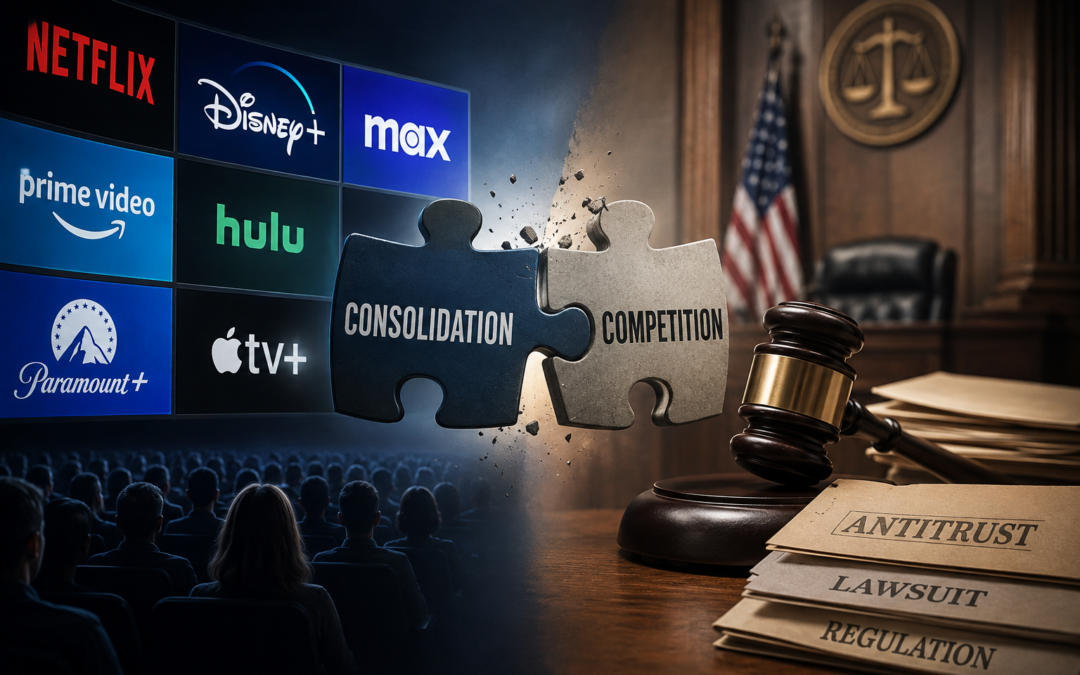
Now the deals are the news, but not the way anyone in Hollywood or Silicon Valley planned. The same week five major media companies proved — for the first time, simultaneously — that streaming can actually make money on its own, the biggest deal on the board got dragged into a courtroom that won’t open until March 2027. Consolidation didn’t stop. It just ran headfirst into antitrust law, and now we’re watching two stories collide: an industry that finally figured out how to turn a profit, and a dealmaking spree that’s discovering profit doesn’t automatically buy you a green light.
Paramount-WBD: from handshake to holding pattern
Paramount Skydance’s $110–111 billion bid for Warner Bros. Discovery was supposed to be the deal that reshaped the whole cable-and-streaming map. Instead, it’s become a case study in how fast goodwill evaporates once state attorneys general get involved.
In July, a coalition of 12 states — led by California’s Rob Bonta — sued to block the merger, arguing it would combine two of the top three cable programmers and two of the top five film distributors and hand the resulting company too much leverage over basic cable, tentpole releases, and theatrical distribution. A judge granted a temporary restraining order, Paramount agreed to hold off closing, and by mid-August a trial date was set: March 2, 2027.
That date matters because Paramount doesn’t get to just wait it out for free. Starting October 1, the company starts accruing a $7 million-per-day “ticking fee” payable to WBD shareholders until the deal closes — a tab that could hit roughly $1.2 billion by the time the trial wraps. Paramount’s response was to countersue, asking the states and the WGA (who filed their own suit) to post a $1.9 billion bond to cover its losses if it ultimately wins. Ellison, for his part, used a New York Times op-ed to argue the real fight isn’t about market share at all — it’s about who gets to own CNN.
Bonta isn’t backing down either. He told CNBC in late August that any settlement would require “robust structural remedies,” not a conversation about streaming competition, which he says isn’t even part of the states’ complaint.
Bottom line: this deal isn’t dead, but it’s not close to done. The industry spent a year assuming Paramount-WBD was inevitable. It’s now genuinely an open question whether it survives a trial seven months from now — and every month it drags on, it’s getting more expensive for the company chasing it.
Comcast’s turn to split
While Paramount fights in court, Comcast is running its own version of the WBD playbook — minus the lawsuit, for now. Having already spun cable networks into Versant, Comcast confirmed in late June it will separate NBCUniversal and Sky into their own publicly traded company.
The timing is doing a lot of work here. Weeks after announcing the split, NBCUniversal struck a deal to put Peacock content — NFL and NBA games, Bravo, the Minions franchise, all of it — inside YouTube Premium starting early next year. That’s a company hedging two ways at once: building scale through a licensing partnership with the biggest video platform on earth, while simultaneously freeing NBCU to be acquired, merged, or otherwise repositioned once it’s untethered from broadband and cable. Variety’s already floated the obvious question — could Netflix, having lost WBD to Paramount, come back for NBCU instead? Most analysts think it’s a stretch, but the fact that the question is being asked seriously tells you where the market’s head is.
Fox and Roku: the quiet one
Fox’s $22 billion Roku acquisition hasn’t generated headlines the way Paramount-WBD has, but it might end up being the more interesting long-term bet. Fox doesn’t have the content scale of the other players, and Fox One isn’t going to out-muscle Netflix or Disney+ on subscribers. What Roku gives Fox is a distribution and ad-tech layer — the thing last quarter’s piece flagged as the real battleground. Whether Fox positions itself as a licensing partner (like NBCU is doing with YouTube) or tries to build its own walled garden with Roku as the front door is still an open question. Either way, it’s a company betting that owning the pipe matters as much as owning the shows.
Meanwhile, the business actually works now
Here’s the part that makes the courtroom drama so ironic: Q2 2026 was the first quarter where all five major studios’ direct-to-consumer businesses reported profits at the same time. Netflix posted $12.6 billion in quarterly revenue at roughly 33% operating margin. Disney+ and Hulu’s combined profit more than doubled to $712 million, with streaming operating margin cracking double digits for the first time. Even Peacock — still in the red — got Comcast executives calling this “peak EBITDA dilution” and promising profitability is next quarter’s story.
Translation: the thing all these mergers were supposedly chasing — a profitable, sustainable streaming business — largely already exists without them. Paramount doesn’t need WBD to prove DTC can work. Comcast doesn’t need to stay bundled with cable to make NBCUniversal valuable. The deals aren’t rescue missions anymore; they’re bets on scale for its own sake, and regulators are increasingly willing to ask whether that scale actually benefits anyone but the shareholders making the bet.
Sports keeps being the exception to every rule
One place where scale unambiguously still matters: live sports. ESPN’s direct-to-consumer app just passed its one-year mark with the NFL now holding a 10% equity stake in the network and WWE’s premium events folded in. The NBA’s 11-year, three-way media deal enters year two this October, split across ESPN/ABC, NBC/Peacock, and Amazon Prime Video — every national game streams somewhere, but fans increasingly need two or three subscriptions to see all of it. Sports remains the one category where fragmentation hasn’t been fixed by any of this consolidation; if anything, it’s gotten more fragmented while everyone was busy fighting over movie studios.
Where this leaves us
The last time we wrote about this industry, the question was who gets bought. The better question right now is whether buying anything is even worth it. The five biggest names in streaming just showed the whole world they don’t need a merger to be profitable — they need better ad tiers, better bundling, and better sports rights math. The mergers still on the table are increasingly about defense and leverage, not survival. And for the first time in this consolidation cycle, a courtroom — not a boardroom — might be the one that decides how it all shakes out.