
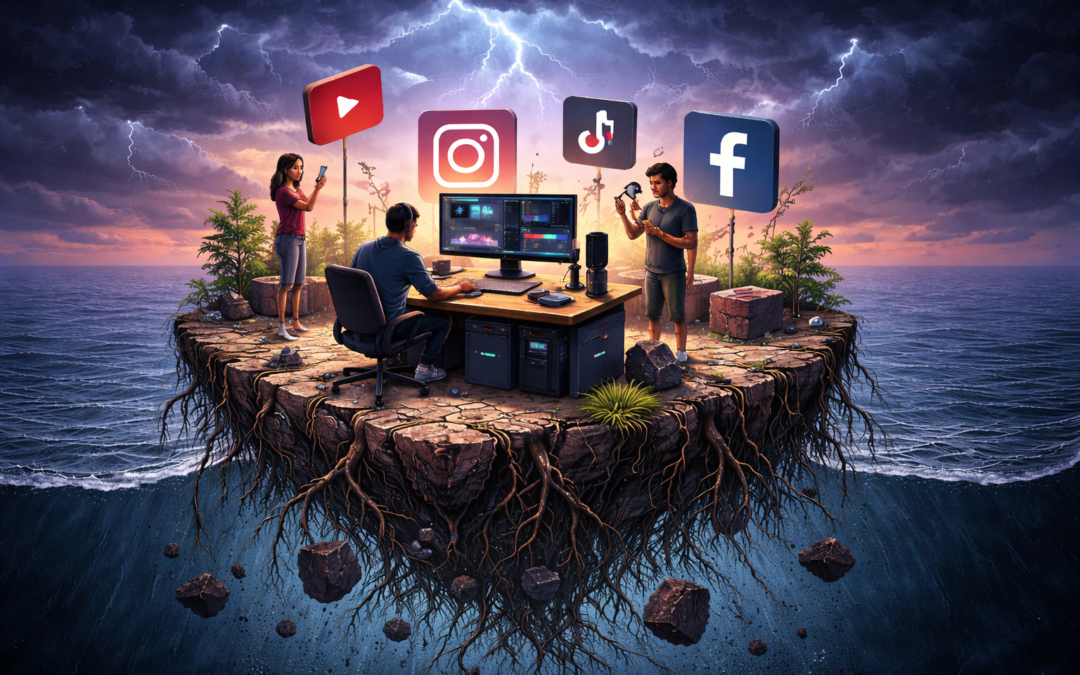
Over the last decade, millions of creators have built audiences on platforms like YouTube, Instagram, TikTok, and Facebook.
These platforms have opened extraordinary opportunities. A single video can reach millions of viewers. A podcast can attract listeners across the world. Independent creators now have tools that once belonged only to major studios and broadcasters.
But beneath this exciting creative revolution lies a quiet risk that many creators rarely consider.
Most creators are building their media presence on borrowed land.
The platforms where creators publish their content are not neutral infrastructure. They are private companies with their own business models, priorities, and rules. Creators benefit from the reach these platforms provide, but they do not control the environment in which their work is distributed.
This distinction matters more than many creators realize.
The Platform Illusion
When a creator gains followers on a platform, it often feels as though they “own” that audience.
A YouTube channel might show hundreds of thousands of subscribers. A TikTok account might accumulate millions of views. An Instagram profile may display a rapidly growing follower count.
But these numbers can create a misleading sense of security.
Creators do not control the algorithms that determine which viewers see their content. They do not control the monetization policies that govern advertising revenue. They do not control the content guidelines that determine what can or cannot be published.
And they certainly do not control the long-term stability of the platform itself.
At any moment, the rules can change.
The History of Platform Shifts
The digital media landscape is filled with examples of platforms rising rapidly and then fading just as quickly.
MySpace once appeared unstoppable in the early days of social media before losing relevance to Facebook. Vine attracted millions of creators before shutting down entirely. Facebook itself dramatically reduced organic reach for publishers who had built enormous audiences on the platform.
Even today, some of the largest platforms face regulatory pressure, competitive threats, and shifting audience behavior.
These shifts remind us that platforms are not permanent foundations for media businesses.
They are distribution environments.
And distribution environments change.
Discovery vs Ownership
Platforms are incredibly powerful tools for discovery.
Algorithms can introduce a creator’s work to audiences that would have been impossible to reach in the traditional broadcast era. A single post can travel far beyond a creator’s immediate network.
For this reason, platforms will likely remain essential parts of the creator ecosystem.
But discovery is not the same as ownership.
Creators who rely entirely on a single platform are placing their audience relationships inside a system they do not control. When that system changes, their reach and influence may change with it.
This is why experienced creators often try to build multiple pathways to their audience.
Newsletters.
Websites.
Membership communities.
Independent distribution channels.
These environments provide creators with more direct relationships with their audiences.
The Shift to Creator-Owned Media
The collapse of the traditional broadcast model has created extraordinary opportunities for independent creators.
Production tools are accessible. Distribution platforms are global. Audiences are increasingly drawn to niche communities and specialized voices.
But the creators who thrive in this environment often think differently about their strategy.
Instead of treating platforms as permanent homes, they treat them as entry points into a larger media ecosystem.
Platforms help audiences discover their work. But the creator’s long-term goal is to build a network of relationships that can survive changes in those platforms.
In other words, creators who succeed in the long run are often those who move gradually from borrowed land to ground they control.
The New Creator Strategy
None of this means creators should abandon platforms.
Platforms remain some of the most powerful discovery engines ever created.
But creators who understand the structure of modern media tend to approach platforms with a different mindset.
They publish content where audiences gather.
They experiment with new tools and formats.
They benefit from algorithmic discovery.
But they also design strategies that extend beyond any single platform.
Because the digital landscape will continue evolving.
And creators who build their entire media presence inside one system may find themselves vulnerable when that system inevitably changes.
The future of independent media will belong to creators who understand not only how to create content — but how the media system itself actually works.