
Every day, millions of creators upload videos to YouTube, TikTok, Instagram, and dozens of other platforms hoping for the same outcome:
A viral moment.
The dream is simple. Post a video, the algorithm picks it up, millions watch it, and a creator’s life changes overnight.
And occasionally, that happens.
But the truth about virality is very different from the story most creators tell themselves.
Virality is not a strategy.
It’s an event.
And for the overwhelming majority of creators, it’s an event that will likely never occur.
The Viral Lottery
To understand why virality is rare, we first have to understand the scale of the creator economy.
According to widely reported platform data:
-
More than 500 hours of video are uploaded to YouTube every minute
-
That equals over 720,000 hours of new video every day
-
TikTok users upload tens of millions of videos daily
-
Instagram and Facebook add millions more pieces of content every day
Across all platforms, billions of pieces of content compete for attention every single day.
Against that backdrop, only a tiny percentage of videos ever achieve viral reach.
Depending on how “viral” is defined, studies suggest that well under 1% of content ever crosses the one-million-view threshold.
When creators talk about virality—10 million views, 50 million views, or more—the percentage becomes far smaller than one percent.
In practical terms:
Well over 95% of creators will never experience a viral video.
Not because their ideas are bad.
Not because they lack creativity.
But because the math simply doesn’t allow it.
Audience attention is finite, while the volume of content competing for that attention continues to grow every year.
The Creator Economy Is Massive
The number of people creating content today is staggering.
Estimates suggest there are now:
-
More than 200 million content creators worldwide
-
Over 50 million people creating content professionally or semi-professionally
-
More than 10 million creators actively producing video content
But when we look at income data, the picture becomes clearer.
Research across the creator economy consistently shows:
-
Only about 2% of creators earn enough to make a full-time living from content creation
-
The vast majority earn little or no income at all
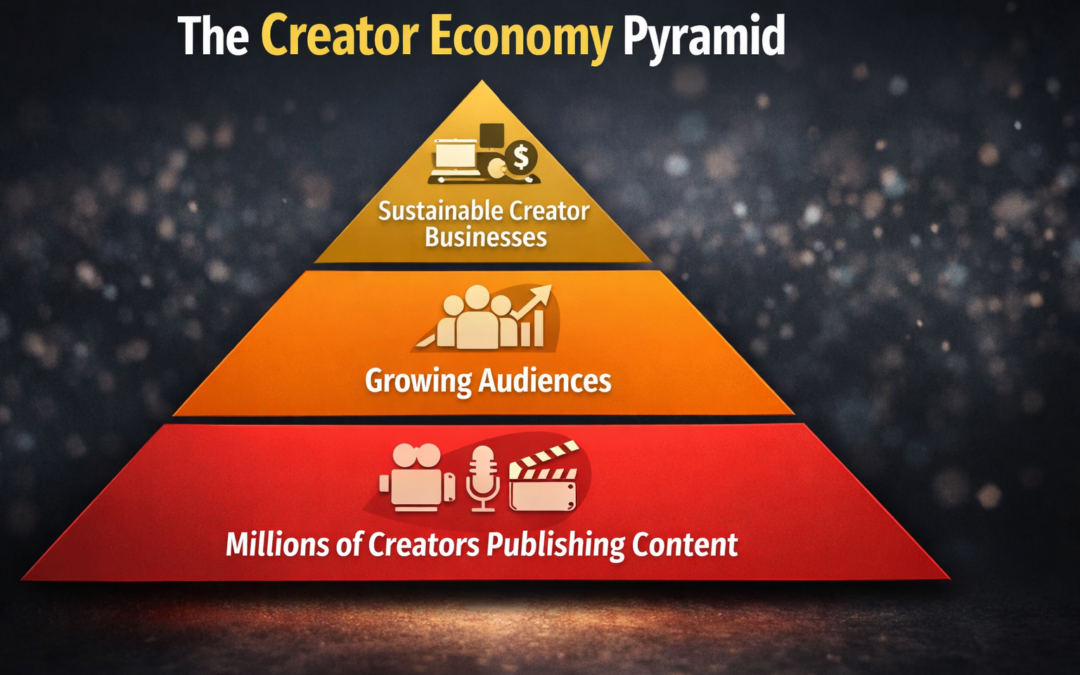
This gap between creative output and economic success is one of the defining realities of the modern creator economy.
And at the center of that gap is a simple issue:
distribution.
Even Viral Creators Rarely Stay Viral
Another myth about virality is that once a creator experiences it, they’ve permanently “made it.”
In reality, many creators who experience a viral video never replicate that success again.
A viral video may generate:
-
millions of views
-
thousands of new subscribers
-
media attention and short-term buzz
But when the next video is published, view counts often return to normal levels.
That’s because virality is driven by momentum and timing, not necessarily long-term audience development.
A viral event may be triggered by:
-
cultural timing
-
trending topics
-
algorithmic amplification
-
large share cascades
-
or pure randomness
But none of those factors guarantee that the next video will perform the same way.
In other words:
A viral video is not the same thing as building an audience.
The Three Myths of the Creator Economy
As the creator economy has grown, several myths have become widely accepted as fact.
But these myths often lead creators in the wrong direction.
Myth #1 — The Viral Myth
Many creators believe success begins with a viral video.
In reality, virality is rare and unpredictable.
The majority of successful creators built audiences gradually over time, not through a single breakout moment.
Virality may accelerate growth—but it rarely creates a career by itself.
Myth #2 — The Algorithm Myth
Another common belief is that creators are simply waiting for the algorithm to “pick them.”
But algorithms are not searching for random viral events.
They are designed to reward signals such as:
-
viewer retention
-
engagement
-
watch time
-
repeat viewing
-
audience relevance
Algorithms amplify content that already performs well with audiences.
They do not manufacture success out of thin air.
Myth #3 — The Follower Myth
Many creators focus heavily on follower counts.
But follower numbers alone rarely determine success.
What matters far more is active audience engagement.
A creator with 10,000 highly engaged viewers may have far more influence than someone with 500,000 passive followers.
Audience quality often matters more than audience size.
The Real Problem Creators Face
For most creators, the challenge isn’t creativity.
The challenge is distribution.
Anyone can publish content today. That barrier has disappeared.
But getting people to actually see that content is a completely different challenge.
Millions of creators are producing videos, podcasts, films, and shows with no clear strategy for how those projects will reach an audience.
They are hoping discovery will happen automatically.
Most of the time, it doesn’t.
The Shift From Virality to Distribution
Successful creators and media companies think differently.
Instead of asking:
“How do we go viral?”
They ask:
“How do we distribute this?”
Distribution means intentionally placing content in front of audiences across multiple channels and platforms.
In the traditional television era, distribution meant getting onto a network.
Today it can include:
-
streaming platforms
-
creator platforms
-
niche communities
-
newsletters
-
podcasts
-
partnerships
-
targeted advertising
-
cross-platform syndication
Creators who understand distribution are no longer dependent on a single viral moment.
They are building systems that allow audiences to discover their work consistently.
The Creators Who Win Long-Term
The most successful creators today are not necessarily the ones who go viral once.
They are the ones who build repeatable audience growth.
They understand that:
Virality may create attention.
But distribution builds a career.
Instead of hoping for a lightning strike, they build systems that steadily expand their reach over time.
This approach may not create overnight fame.
But it creates something far more valuable:
a sustainable audience.
The Future of Independent Media
The creator economy has opened incredible opportunities.
Anyone with an idea and a camera can now publish their work to the world.
But the next phase of the creator economy will belong to those who understand something deeper:
Creating content is only the beginning.
Distribution determines whether that content actually reaches people.
Virality will always exist. It will always produce occasional breakout stars and cultural moments.
But the creators who build lasting influence will be those who stop chasing virality and start building distribution strategies.
Because in modern media:
Virality is an event.
Distribution is a strategy.
The Creator Economy Is Entering Phase Two
The first phase of the creator economy was about access.
For most of the last century, creating and distributing media required permission from powerful institutions. Television networks, film studios, record labels, and publishing houses controlled the pathways to audiences.
The internet changed that.
Platforms like YouTube, TikTok, podcast networks, and streaming services removed the barriers to entry. Suddenly anyone with an idea, a camera, and an internet connection could publish their work to the world.
That shift created the first phase of the creator economy:
Anyone can create.
And millions of people did.
But as the creator economy has matured, a new reality has emerged.
When millions of creators are publishing content every day, the real challenge is no longer creation.
The challenge is discovery.
Which leads us to the second phase of the creator economy.
Phase Two: Distribution Wins.
In this new phase, the creators who succeed will not necessarily be those who produce the most content.
They will be the creators who understand:
-
how audiences discover content
-
how content travels across platforms
-
how to place their work in front of the right communities
-
how to build sustainable audience growth over time
In other words, they will understand distribution.
The next generation of successful creators will think less like hobbyists and more like media companies—developing projects, building audiences, and expanding their reach strategically rather than hoping for a viral breakthrough.
The Real Opportunity for Independent Creators
Ironically, this shift may actually favor independent creators.
Large studios and legacy media companies are still adapting to the rapid changes in digital distribution.
Independent creators, on the other hand, have the freedom to experiment, build niche audiences, and distribute their work across multiple platforms without the constraints of traditional media structures.
Those who learn to combine creative storytelling with intentional distribution strategies will have an enormous advantage in the years ahead.
Because while the tools for creation have become widely available, the ability to build and grow an audience intentionally remains rare.
And rare skills are where opportunity lives.
A New Approach for Creators
As the creator economy continues to evolve, more creators are beginning to recognize that success in modern media requires more than just producing great content.
It requires understanding how projects move from idea to launch, from launch to distribution, and from distribution to sustained audience growth.
That shift in thinking is one of the core ideas behind the WingDing® Creator Guild, where creators explore how modern media works in practice—how projects are developed, how audiences are reached, and how independent creators can build real distribution strategies in a rapidly changing landscape.
For creators who want to move beyond hoping for discovery and begin building intentional audience growth, the conversation around media is beginning to change.
And it starts with one simple realization:
Virality is an event.
Distribution is a strategy.