
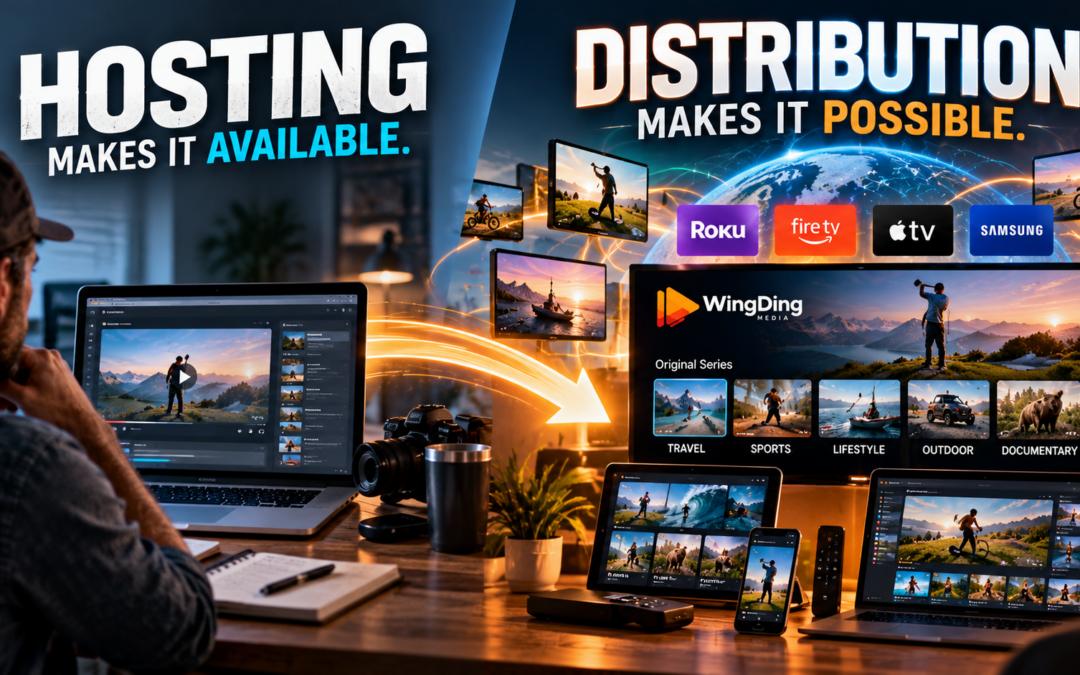
You’ve invested the time, talent, and money to produce great video content. But getting it online and getting it watched are two very different things.
There’s an interesting problem in the video production business that doesn’t get nearly enough attention.
We’ve become very good at creating content. Cameras are better, editing software is more accessible, and independent producers can create programming that rivals what major television networks were producing not so long ago.
But somewhere between finishing the edit and uploading the final video, an important part of the business often gets overlooked.
What happens to the content after it’s published?
For many creators, the answer is surprisingly simple. They upload it to a video hosting platform, embed it on their website, share it on social media, and hope people watch.
Then they start working on the next video.
There’s nothing wrong with that process. But there’s a fundamental difference between making content available and developing a strategy to get that content in front of an audience.
It’s the difference between video hosting and video distribution.
And understanding that difference can change how you think about the value of everything you’ve created.
What Is Video Hosting?
Video hosting is exactly what it sounds like. It’s the technology and infrastructure that allows you to upload, store, manage, and play video content online.
Platforms like Vimeo, Wistia, and other professional hosting services provide valuable tools for creators and businesses.
Depending on the service, those tools can include customizable video players, website embedding, privacy controls, analytics, storage management, and collaboration features.
For many users, that’s precisely what they need.
A business creating employee training videos needs a reliable way to store and deliver that content. A wedding videographer may need private galleries for clients. A marketing agency may want a professional-looking video player embedded on a client’s website.
Video hosting solves those problems.
But hosting alone doesn’t necessarily create an audience.
Think of it this way: You can build a beautiful theater, install the finest projection equipment, and have an incredible film ready to play.
None of that guarantees anyone will buy a ticket.
You still have to give people a reason to come.
What Is Video Distribution?
Video distribution is the process of making content available through channels and platforms where viewers can access it.
That might include streaming television applications, connected TV devices, on-demand media platforms, mobile apps, websites, and other digital destinations.
The objective isn’t simply to keep a video file accessible. It’s to create opportunities for the content to reach viewers beyond its original publishing location.
For example, an independent producer might host a documentary series on a website. Visitors can watch the episodes there, provided they know the website exists.
But that same producer might also explore distribution through a streaming television environment where viewers consume programming on their living room televisions.
Suddenly, the producer is thinking about the content as programming rather than simply a collection of videos.
That’s a different approach to building a media business.
And it’s worth understanding that distribution doesn’t automatically mean audience growth. Making programming available on additional platforms creates access, but attracting viewers still requires discoverability, promotion, and content people want to watch.
Distribution opens doors. Audience development gives people a reason to walk through them.
The Three Parts of a Successful Video Strategy
For creators hoping to build something sustainable, we believe there are three essential elements.
1. Content: Give People Something Worth Watching
Everything starts with the programming.
Whether you’re producing a travel series, sports competition, documentary, cooking show, or educational program, the content needs to deliver something meaningful to its intended audience.
That doesn’t necessarily require Hollywood production budgets.
It requires understanding who the audience is and why they would want to watch.
A niche sports documentary may never appeal to everyone, but it doesn’t have to. It needs to appeal to the people who care about that sport.
2. Distribution: Make the Content Accessible
Once the content exists, the next challenge is deciding where it belongs.
Should it live exclusively on your website? On YouTube? In a branded streaming application? On connected television platforms? Across several destinations?
The answer depends on the content, its audience, distribution rights, and the producer’s goals.
A thoughtful distribution strategy considers where potential viewers already spend their time and which platforms provide a practical way to reach them.
The goal isn’t necessarily to be everywhere.
It’s to be in the right places.
3. Audience Development: Give Viewers a Reason to Find You
This is where many content strategies fall short.
Getting a show onto a streaming platform is an accomplishment. But it’s not the end of the job.
People still need to know the show exists.
That might require social media promotion, search engine optimization, paid advertising, public relations, partnerships, email marketing, or cross-promotion with other creators.
And once someone discovers the programming, the experience should encourage them to return.
Strong branding, consistent publishing, recognizable series formats, and compelling programming all contribute to that process.
Content, distribution, and audience development work together. Neglecting any one of them can limit the effectiveness of the others.
Your Existing Video Library Is an Asset, Not Just an Archive
Here’s something worth considering if you’ve been producing video for several years.
How much finished content do you already own?
Maybe you’ve produced 30 episodes of a travel show. Perhaps you’ve recorded five seasons of a sports competition. You might have hundreds of interviews, instructional programs, documentaries, or other videos sitting in a hosting account.
You paid to create that content. You invested the time and resources. You own the rights, or at least have the necessary permissions to use it.
Yet much of it may no longer receive meaningful attention.
That’s an opportunity worth investigating.
A library of evergreen content can potentially be reorganized into programming collections, featured series, themed channels, or other streaming experiences.
Older episodes may be new discoveries for audiences who weren’t familiar with your work when it was originally released.
And existing content can often be repurposed into shorter promotional clips, social media features, or new programming packages.
Not every video will have lasting value. Some subjects become outdated, and distribution rights may restrict how older content can be used.
But before investing in the next production, it’s worth asking whether the content you’ve already created is working as hard as it could.
From Video Creator to Media Brand
One of the more interesting changes in digital media is that independent creators no longer have to think exclusively in terms of individual videos.
They can think in terms of programming brands.
Consider a producer who creates a series about recreational fishing.
At first, the business may revolve around producing episodes and posting them online.
But as the library grows, the producer begins to develop something more substantial.
There’s a recognizable show, an audience with shared interests, a growing catalog of programming, and perhaps relationships with manufacturers, destinations, retailers, and sponsors.
At that point, the opportunity extends beyond individual video views.
The producer has the beginnings of a specialized media property.
That property might support sponsorship packages, branded programming, advertising relationships, content licensing, or partnerships with other media organizations.
None of those revenue opportunities are guaranteed. They require audience engagement, sales effort, and a sound business model.
But the potential changes when creators begin thinking about their content as part of a larger media business.
A video is something you publish. A media brand is something you build.
Where Connected Television Fits Into the Picture
For decades, television distribution was largely controlled by broadcasters, cable networks, and a relatively small group of media companies.
Independent producers often needed relationships with those organizations to reach viewers through traditional television.
Streaming technology has created additional paths.
Connected television platforms, including Roku, Amazon Fire TV, Apple TV, and other supported streaming environments, allow audiences to watch digital programming on television screens.
For creators, that opens up opportunities to present content in an environment that feels more like television programming and less like browsing a collection of individual web videos.
There are different ways to participate in that ecosystem.
Some media businesses operate branded streaming applications. Others work through established streaming services or content distribution partners.
The right approach depends on the size and quality of the content library, audience potential, technical requirements, available resources, and business objectives.
Importantly, availability on a connected TV device is not the same as guaranteed placement within a major streaming service. Each platform and distribution arrangement has its own requirements.
But for creators with substantial programming libraries, connected television can be an important part of a broader distribution strategy.
Distribution and Monetization: The Relationship Matters
One of the first questions creators ask about expanded distribution is whether it can generate revenue.
It’s a reasonable question, especially when considerable money has already been invested in production.
Potential revenue models include advertising-supported programming, sponsorships, subscription access, pay-per-view events, licensing arrangements, and branded content partnerships.
Not every model works for every creator.
A niche sports organization may find value in event sponsorships and advertising partnerships. A documentary producer might explore licensing opportunities. An educational content provider may have a business case for subscription access.
The important point is that distribution and monetization need to be considered together.
Simply placing a video on more platforms doesn’t create a business model.
A sustainable strategy requires understanding the audience, the value of reaching that audience, and how revenue opportunities fit the programming.
In many cases, a smaller but highly engaged audience may be more attractive to a relevant sponsor than a larger audience with little connection to the brand.
That’s why effective media distribution should be about more than accumulating views.
It should be about creating value.
How WingDing Media Approaches Video Distribution
At WingDing Media, we’ve built our business around helping content creators, producers, and organizations explore opportunities beyond traditional video hosting.
We’re not trying to compete with companies whose primary business is storing video files.
Our interest is in what happens after the content is produced.
Through our streaming distribution infrastructure, we help make programming available across supported digital and connected television environments.
But technology is only part of the equation.
Our background in digital marketing, video production, advertising, and media development allows us to approach content distribution as part of a larger strategy.
That can include helping creators organize their programming, develop branded media experiences, explore monetization opportunities, and promote their content to relevant audiences.
We work with the understanding that every creator’s situation is different.
Some have established shows and substantial libraries. Others are building a new programming concept. Some are focused on audience growth, while others want to explore sponsorship or advertising opportunities.
The objective is to identify a distribution approach that makes sense for the content and the business behind it.
And sometimes, the best starting point is simply understanding what the creator already has.
Five Questions Every Video Creator Should Ask
Before choosing another hosting provider, investing in additional production, or launching a streaming channel, consider these questions:
- Who is my audience? Not just how many people watch, but who they are and what interests them.
- Where does that audience consume content? Are they primarily watching on mobile devices, websites, social platforms, or connected televisions?
- How much valuable content do I already own? Could existing programming be reorganized, repackaged, or distributed more effectively?
- What am I trying to accomplish? More exposure, stronger branding, sponsorship revenue, audience growth, or an independent media business?
- Do I have a distribution strategy or just a place to upload videos? The difference may be more important than you think.
The answers won’t be the same for everyone.
But they can help determine whether your current approach is supporting your goals or simply maintaining your video library.
Hosting Is Where Your Content Lives. Distribution Is Where Its Next Opportunity Begins.
There’s nothing wrong with using a professional video hosting service. For many businesses and creators, it’s an essential tool.
But for those producing content intended for an audience, hosting should be viewed as one component of a larger strategy.
The real opportunity lies in understanding how your content can reach viewers, build recognition, encourage engagement, and potentially create lasting value.
And if you’ve already invested years in producing quality programming, that opportunity may be sitting in your existing library.
At WingDing Media, we believe the conversation shouldn’t end when the video is uploaded.
In many ways, that’s where the most interesting part begins.
You’ve created the content. Let’s explore what it can become.
WingDing Media helps independent producers, sports organizations, and content creators explore streaming distribution, audience development, and media monetization opportunities. Contact us to discuss your content and where you want to take it next.